What Is a Cloud Commerce Platform for Microsoft CSPs?
CloudCockpit Team | Published: October 15, 2026 | Last updated: October 22, 2026
A cloud commerce platform is software that connects to Microsoft Partner Center and runs a partner's daily CSP operations in one place: customers, orders, subscriptions, pricing and billing. Some partners call it a CSP management platform. Direct-bill partners are the ones who most often need one, because Microsoft assesses their billing and provisioning systems as part of CSP eligibility. This guide defines:
- The category;
- Explains who can use one and;
- Shows how to tell when spreadsheets stop being enough.
What is a CSP Management platform or Cloud Commerce Platform?
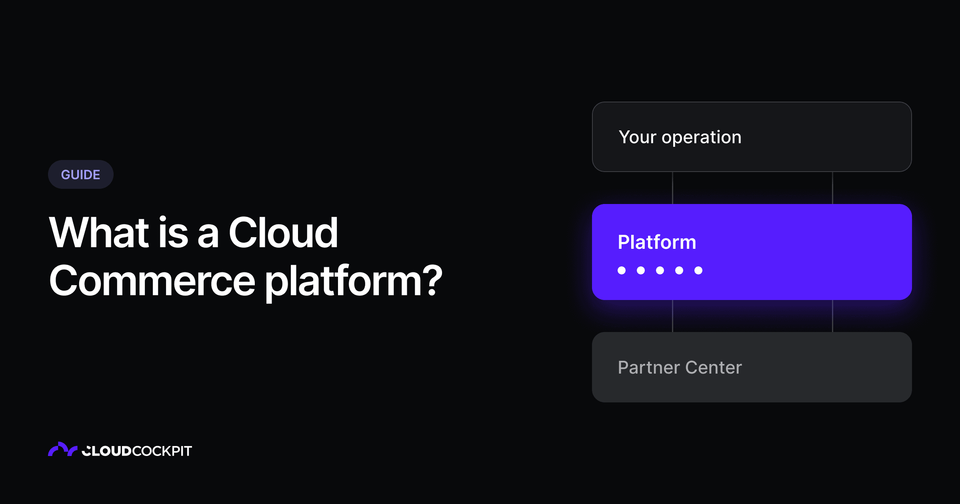
A CSP management platform is a system that integrates with Partner Center through its APIs so a Cloud Solution Provider (CSP) partner can manage customers, orders, subscriptions, pricing and billing from one interface. Microsoft does not define this term in its documentation. This guide uses it for the tooling that sits between Partner Center and a partner's own sales, finance and support processes.
Because Microsoft does not define this category, vendors and partners use several labels for it, and they sometimes appear together on the same page. Alongside cloud commerce platform and CSP management platform, you will also see CSP management system, CSP automation and billing platform and subscription commerce platform. The names overlap more than they differ. When you compare options, look at what the software does rather than at what it is called.
Microsoft describes the Partner Center REST API as the way CSP partners integrate existing CRM or billing software with the systems that manage customer accounts, orders, subscriptions and support requests. A platform is built on that API.
Most platforms cover five jobs:
- Catalog and pricing: import the Microsoft catalog and apply the partner's own prices and margins per offer or per customer.
- Ordering and provisioning: place orders in Partner Center and track subscription changes, renewals and cancellations.
- Billing: turn Microsoft's reconciliation data into customer invoices and compare them with the Microsoft invoice.
- Access: give the CSP, its resellers and its customers different views and self-service options.
- Reporting: show consumption, renewals and margin.
For a Direct Bill partner, these five jobs are the daily operation of the CSP business, and a platform decides how much of it runs by hand.
Who can use a Cloud Commerce Platform?
Direct-bill (Distributor or Direct Partner) partners are the main users, because they hold the billing relationship with Microsoft and place orders in Partner Center themselves. Microsoft supports three transactional relationship types in the CSP program:
| Model | Relationship with Microsoft | Who places the order |
|---|---|---|
| Direct-bill partner | Buys Microsoft and third-party offers directly from Microsoft and sells to its customers | The partner |
| Indirect provider (distributor) | Buys from Microsoft and resells to indirect resellers | The provider, on behalf of its resellers |
| Indirect reseller | No direct billing relationship with Microsoft, depends on indirect providers to transact | The indirect provider, on behalf of the reseller |
Indirect resellers therefore work through their provider's tooling, and Microsoft notes that different providers offer different support and services. Microsoft's transition guidance also states that a partner who moves from direct-bill to indirect reseller loses access to the sandbox and Partner Center API capabilities.
If you are an indirect reseller, the platform decision usually belongs to your provider. If you are a direct-bill partner, it belongs to you.
CloudCockpit note: In our experience, some partners believe they are direct-bill partners when they actually buy through an indirect provider. The practical test is who places your orders and who sends you the Microsoft invoice. CloudCockpit connects to Partner Center, so it works with partners that buy directly from Microsoft.
What does Microsoft require from a direct-bill partner's systems?
Microsoft's direct-bill eligibility assessment covers billing and provisioning systems, described as "automated platforms based on API integration with Partner Center." That item sits under the Sell capabilities in the CSP eligibility requirements, next to sales force, managed services and solution expertise. Since October 2025, direct-bill partners are reassessed annually.
The minimum requirements to apply to enroll as a direct-bill partner include:
- At least 12 months transacting as an indirect reseller, and at least USD 1 million in eligible CSP revenue during the preceding 12 months at the Partner Global Account (PGA) level.
- An active Microsoft AI Cloud Partner Program (MAICPP) membership and a Partner Location Account (PLA) ID for the location where you sell.
- At least one enrolled Solutions Partner designation.
- An active Microsoft support plan, either Advanced Support for Partners or Premier Support for Partners.
- The mandatory Partner Center security requirements: multifactor authentication for all administrators, a designated security contact and responses to security alerts within 24 hours.
At renewal, direct-bill partners need at least USD 1 million in trailing 12-month Direct Bill CSP revenue at the PGA level, and a partner that misses a requirement must transition to indirect reseller status.
A platform does not satisfy these requirements by itself. It is one way to cover the billing and provisioning capability without building the Partner Center integration in house.
How does a platform handle Microsoft billing and reconciliation?
A platform uses Microsoft's reconciliation data to bill customers and to check that what the partner charges covers what Microsoft invoices. In the new commerce experience, the billing period is a full calendar month and Microsoft publishes the invoice by the 8th day of the following month.
Reconciliation files list every charge and credit for the period, and the billed file matches the total of the invoice line items. An unbilled file gives near-real-time estimates for the open period and is available only to partners in the new commerce experience. Microsoft's guidance is to build customer invoices from the customer details in reconciliation files, and both file types are also available through Partner Center billing APIs.
The monthly reconciliation covers license-based products, Azure pay as you go, reservations, savings plans and SaaS products listed in Microsoft Marketplace. Partners that sell through both channels can read how CloudCockpit handles Microsoft Marketplace subscriptions in the CSP channel.
CloudCockpit note: Budget alerts and billing run on different numbers in CloudCockpit. Alerts use the estimate synced from Partner Center, while billing runs on Microsoft's monthly reconciliation file, and the two are not the same numbers. Microsoft describes the unbilled file as a projection and the billed file as the one that matches the invoice, so only the billed file should drive customer invoices.
A billing process built on reconciliation data, not on estimates, is what lets a Direct Bill partner explain any difference between what it charged and what Microsoft invoiced.
Why does a platform keep its own copy of Partner Center data?
CloudCockpit copies each partner's Partner Center data (resellers, customers, subscriptions and billing details) into a dedicated database every night.
A single portal page can need data on hundreds of customers and thousands of subscriptions, which would be slow to fetch live. Billing and trend reports need to know what was true last month, not only today.
The trade-off is timing. Changes made directly in Partner Center appear after the next import, while orders placed in the platform are recorded at once. A single customer can also be synced on demand.
CloudCockpit note: When you evaluate any platform, ask whether it records your own orders immediately and how it picks up changes made directly in Partner Center. The answer decides how much you can trust the screen at 9 a.m. on the day an invoice is due.
How do you know a spreadsheet or in-house tool is no longer enough?
A spreadsheet or in-house tool stops being enough when growth in offers, channels or customers turns reconciliation into manual work that someone repeats every month. Five signs show up most often:
- You sell through more than one channel, for example direct CSP and Microsoft Marketplace, and reconcile the orders by hand.
- Your catalog is moving from a few products to the full Microsoft catalog.
- Prices are adjusted in a CRM quote and again in the system that provisions the order.
- Microsoft price or program changes have to be applied manually in several places.
- You cannot see, per customer, what you billed against what Microsoft invoiced.
These signs matter more than company size. A partner selling a few products can often manage with a spreadsheet. The same partner selling the full Microsoft catalog usually cannot.
For a Direct Bill partner, the cost of waiting is not only time. It is the risk of billing errors that surface only when the Microsoft invoice arrives.
How should a direct-bill partner evaluate a platform?
Evaluate a platform on how it connects to Partner Center, how it bills and how it fits the tools you already use. Seven questions cover most of the decision:
- Partner Center integration: does it use the Partner Center APIs, and how are changes made outside the platform picked up?
- Billing basis: does it bill from Microsoft reconciliation files and keep billed and unbilled data separate?
- Pricing and margin: can you set prices by offer and by customer, and see margin per line?
- CRM and ERP fit: is every action available by API, and can a CRM quote set the final price so nobody adjusts it twice?
- Access model: can resellers and customers get their own views without seeing the margins of other tiers?
- Catalog: can you list non-Microsoft offers next to the Microsoft catalog?
- Support model: who explains Microsoft program changes to you, and how fast?
Score each question against your own operation, not against a feature list. A platform that fits your billing and CRM workflow will matter more than one with the longest menu.
What do CloudCockpit users say about the platform?
Want to know more about CloudCockpit? See what our users say about the platform on G2. Real user experience carries weight, and it can help you understand some of the reasons partners choose CloudCockpit. Three examples from G2 reviewers:
- David C., Director, Information Technology and Services (G2, February 19, 2026), moved from Cloudmore to CloudCockpit for "a significantly better GUI and overall user experience." He says the platform improved Microsoft 365 and Azure billing and made renewals easier.
- Arnaud B., Associé, Head of Cloud & M365 (Azure & Microsoft 365) (G2, April 16, 2026), says CloudCockpit simplifies billing for CSPs and gives employees centralized access through Microsoft SSO. G2 translated the review from French.
- André H., Director (G2, April 7, 2021), says end users can manage their own licenses with their Office 365 login and monitor their own cost and consumption.
The Bottom Line
A CSP management platform is the layer between Partner Center and your daily operation, and direct-bill partners are the ones who rely on it most.
Microsoft reassesses direct-bill partners every year and sends advance notices starting three months before the CSP onboarded anniversary month, so the billing and provisioning capability should be in place well before then.
The next decision is about scope: as you add offers, channels and CRM workflows, reconciliation stops being a monthly task and becomes the core of how you run the business.
Sources
- Microsoft Learn, Learn how CSP partners can work together
- Microsoft Learn, Requirements to enroll as a CSP direct-bill partner
- Microsoft Learn, Transition from Cloud Solution Provider direct-bill partner to indirect reseller
- Microsoft Learn, What are the Partner Center REST APIs?
- Microsoft Learn, Manage billing (Partner Center APIs)
- Microsoft Learn, Understand your bill and reconciliation data in Partner Center
- Microsoft Learn, Billing overview for Partner Center Cloud Solution Providers program
- G2, CloudCockpit Reviews