Why it matters:
Understanding Microsoft's Modern Commerce Platform
Before diving into features, it's worth understanding what the Microsoft AI Cloud Partner Program requires. Mandatory for all seat-based subscriptions including Microsoft 365, Dynamics 365, Windows 365, and Power Platform:
- Term commitments: 1-month, 12-month, or 36-month subscription terms
- Billing flexibility: Monthly or annual billing (with a 5% premium for annual terms billed monthly as of April 2025)
- 7-day cancellation window: For new subscriptions and seat increases
- Mid-term upgrades: Move customers to higher SKUs without double-paying
- Seat management rules: Reductions only allowed at renewal for annual terms
For partners managing hundreds of customers, each with different term dates, billing cycles, and subscription mixes, the complexity compounds quickly. A cloud commerce platform absorbs this so operations teams don't have to track it manually.
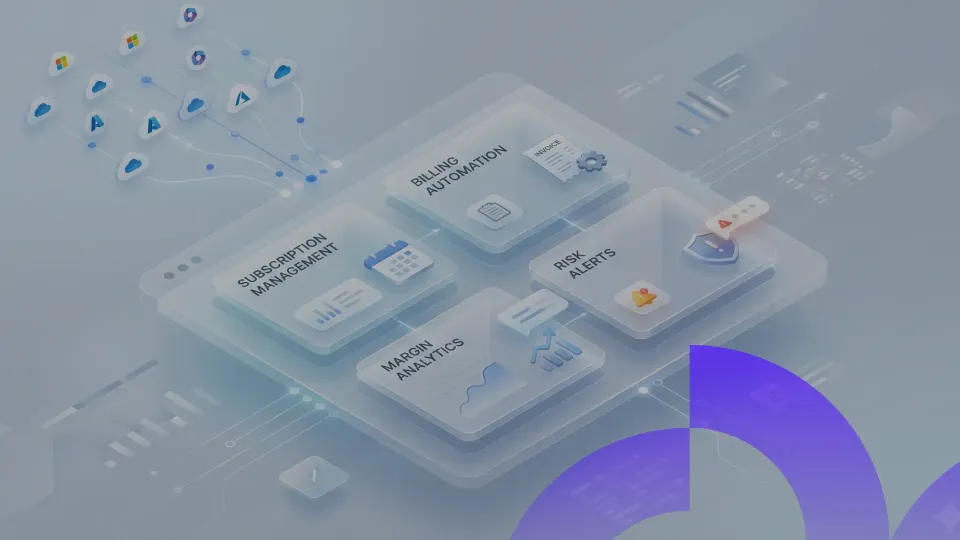
Here's what a complete platform typically includes
Pricing and Margin Management
Microsoft provides pricing to CSP partners, but doesn't offer tools for setting customer-facing prices or managing margins. That's where a management platform becomes essential.
Microsoft delivers:
- Monthly price lists with partner cost prices
- Pricing APIs for Azure Plan consumption
- Reconciliation files for billing verification
What Microsoft doesn't provide:
- Customer-facing price management
- Markup rules by customer, product, or region
- Margin calculation and visibility
Key capabilities of a Cloud Commerce Platform:
- Automatic price list import from Partner Center
- Flexible markup rules at customer, reseller, or product level
- Real-time margin visibility across your portfolio
- Price versioning and change tracking
- Multi-currency and multi-region pricing support
This is where margin protection happens. A partner selling thousands of subscriptions without centralized pricing rules will leak revenue through inconsistent markups, missed price updates, or manual errors. For a closer look at reconciliation workflows, pricing control, and margin visibility, explore Pricing and Margin Management.
Customer and Reseller Portals
Self-service reduces support load. Customers can view their subscriptions, usage, and invoices without tickets.
Key capabilities:
- Customer self-service for subscription and invoice visibility
- Reseller portals with defined management boundaries
- Usage dashboards and billing history access
- Reduced ticket volume for routine inquiries
- The operational leverage here compounds over time.
Provisioning and License Management
The foundation of any Microsoft licensing operation, a management system automates subscription creation, seat changes, and tenant onboarding directly through Microsoft APIs. For a closer look at provisioning, renewals, seat tracking, and lifecycle control, read more about Provisioning and License Management.
Key capabilities:
- Automated subscription provisioning via Microsoft APIs Seat adjustments
- license changes without manual Partner Center work
- Tenant onboarding workflows
- Bulk operations for efficiency at scale
- For growing CSPs, this means scaling without proportionally scaling headcount.
Billing Automation
CSP billing is uniquely complex. Usage-based services, license-based subscriptions, proration rules, and Microsoft's reconciliation files all need to work together.
Key capabilities:
- Invoice generation with accurate margin calculations
- Multi-tier pricing support for reseller channels Automatic reconciliation
- Microsoft billing data
- Usage-based and license-based billing in one system
- Proration handling and billing cycle management
- Errors in this layer directly impact cash flow.
Risk and Credit Controls
This is where operational maturity separates from operational chaos.
Key capabilities:
- High-value transaction alerts
- Credit limit enforcement per customer or reseller
- Unusual subscription pattern detection
- Exposure monitoring across your customer base
- Policy-based controls that act before problems become invoices
For partners managing significant subscription volume, risk visibility isn't optional, it's how you protect margin.
Reporting and Analytics
The difference between knowing what happened last month and understanding where your business is heading.
Key capabilities:
- Revenue tracking and margin analysis
- Microsoft incentive and rebate monitoring
- Portfolio-level insights across customers
- Trend identification and forecasting support
Integrate and Automate at Scale
For true streamline operations the cloud commerce platform has to connect with all the other tools necessary to run your business.
Key capabilities:
- PSA, ERP, and CRM connections
- Webhooks, APIs, and data pipelines
- Flexible field mapping for custom workflows
To understand how CSPs monitor Azure risk, spending patterns, and profitability, read more about Reporting and Analytics.
What CloudCockpit Does
CloudCockpit is a cloud commerce platform for Microsoft Partners. It connects to Partner Center and handles the operational layer that Microsoft doesn't provide.
Provisioning
- Automate tenant creation, subscription provisioning, and licence changes through Partner Center APIs. Read more here
- No manual work for routine operations.
Pricing and margins
- Import Microsoft price lists automatically.
- Set markup rules by customer, reseller, product, or region.
- Track margin in real time across your portfolio.
Billing
- Reconciliation file against Microsoft billing data, and support multi-tier reseller pricing.
- Usage-based and licence-based billing in one system.
- Pro-rata Precision means pay only for the days used. Billing accuracy down to the day
Risk Center
- Monitor transactions for credit exposure and unusual patterns. Set a credit alert per customer. Configure alerts by value, quantity, or subscription type.
- Problems surface before they become invoices.
- Reseller channels. Support multi-tier hierarchies with separate portals, pricing rules, and margin visibility at each level. Read more here
Integrations.
- Connect to PSA, ERP, and CRM systems through APIs and webhooks.
- Flexible field mapping for your existing workflows.
CloudCockpit gives MSPs the visibility and control that Partner Center doesn't, so operations teams spend less time on spreadsheets and more time on growth. Read more here. Technical evaluators often look for proof beyond feature claims. Explore the CloudCockpit API documentation.
Why a Dedicated Microsoft Cloud Commerce Platform Matters
Generic billing tools weren't built for Microsoft CSP. They don't understand term commitments, seat-based licensing, Azure consumption models, or Partner Center reconciliation. They require workarounds. They break when Microsoft changes something.
A platform built specifically for Microsoft AI Cloud Partner Program is different. It lives and breathes this ecosystem. It speaks Microsoft natively. Partner Center APIs, Microsoft price lists, reconciliation files, tenant provisioning. All integrated at the core, not bolted on as an afterthought.
It evolves with the program. When Microsoft changes pricing structures, adds new SKUs, or updates billing rules, a dedicated platform adapts. Generic tools wait for you to figure it out.
Margin protection, credit exposure, multi-tier reseller models, these aren't edge cases. They're the entire business model. A purpose-built platform treats them that way.
It reduces translation work. No mapping Microsoft concepts into generic fields. No spreadsheets to bridge the gap. The platform already thinks in subscriptions, seats, terms, margins and risks.
For partners building a business on Microsoft cloud, the tooling should match the commitment. A dedicated platform isn't a nice-to-have, it's the foundation for operational control at scale.

![Risk Management [Part 4]](https://media.cloudcockpit.com/media/assets/large_managing_financial_risk_in_the_microsoft_csp_program_564aaefd90.webp)