By CloudCockpit Team | Published: June 19, 2026
The short version: Microsoft requires CSP Direct Bill partners to run billing and provisioning through automated platforms with an API integration to Partner Center, verified through a capabilities assessment at enrollment and, since October 2025, every year after. This is Part 1 of a two-part series on the requirement: it covers what the rule actually asks for and what happens if a partner does not meet it. Enforcement of the annual reassessment for already authorized partners is currently paused, and Part 2 covers that pause and what to do about it in detail.
What Does Microsoft Require for CSP Direct Bill Billing and Provisioning?
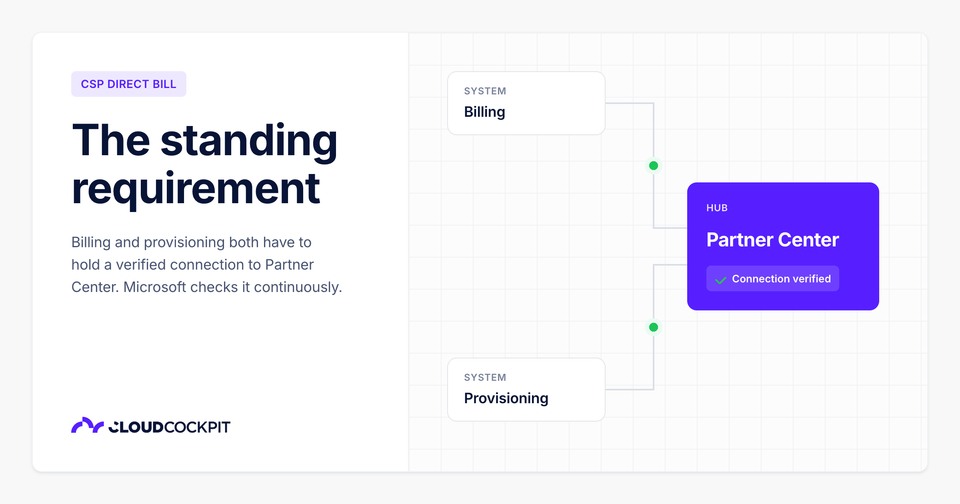
Microsoft requires CSP Direct Bill partners to run billing and provisioning through automated platforms with API integration to Partner Center, not manual entry through the portal. This sits under the "Sell" category of the CSP capabilities standard, alongside technical resources, sales force, managed services, and solution expertise. Microsoft verifies this through an automated capabilities assessment, both when a partner first applies and, since October 2025, on an annual basis.
The two systems evaluated are:
- Billing system: must support automated invoicing, subscription tracking, and transaction reconciliation, evidenced by API integration with Partner Center.
- Provisioning system: must support real time provisioning of licenses, subscriptions, and cloud resources, also evidenced by API integration with Partner Center.
For Direct Bill partners: this is a pass or fail input into the capabilities assessment score, not a soft recommendation. For Indirect Resellers: this requirement does not apply directly, since Indirect Resellers transact through a Distributor rather than integrating with Partner Center themselves.
CloudCockpit Note: an existing billing system that already works well, including one tightly integrated with a partner's own ERP or a local e-invoicing setup, does not automatically satisfy this requirement on its own. What Microsoft checks for specifically is API integration with Partner Center. In most cases, extending an existing system through that API is a lower friction path than replacing it outright.
When Did the Annual Capabilities Reassessment Start?
Microsoft started reassessing existing CSP Direct Bill partners annually in October 2025, not only at initial enrollment. The reassessment happens during each partner's CSP onboarding anniversary month and covers the same capabilities as the pre-enrollment assessment.
At that annual reassessment, a Direct Bill partner also has to meet:
- An active Microsoft AI Cloud Partner Program (MAICPP) membership and Partner Location Account (PLA) ID.
- At least USD 1 million in trailing 12 month (TTM) Direct Bill CSP transactional revenue at the Partner Global Account (PGA) level.
- Renewal of the partner's premium support plan contract.
- All mandatory Partner Center security requirements (MFA for admins, a designated security contact, and security alert response within 24 hours).
- At least one active Solutions Partner designation.
For Distributors: a comparable annual capabilities assessment applies, though this article did not independently verify identical billing and provisioning wording for that partner type.
What Happens If a Direct Bill Partner Doesn't Meet the Requirement?
A Direct Bill partner that misses one or more annual requirements is required to transition to Indirect Reseller status, or faces deauthorization if it does not act in time. Microsoft sends notifications to Global Admins and Billing Admins at set intervals before the deadline, then gives a fixed grace period after it.
The enforcement timeline runs as follows:
- T minus 90, T minus 60, T minus 30 days: courtesy notification emails if the organization is not yet meeting requirements.
- T zero (the CSP anniversary month): if requirements are still unmet, the partner gets a formal notice with 30 days to resolve outstanding issues.
- T plus 30 days: if requirements remain unmet, deauthorization proceedings begin and the partner must support transitioning customer subscriptions to another partner.
Once a partner's Direct Bill capabilities are restricted, it can no longer make new purchases in Partner Center (Azure subscriptions, license based subscriptions, add ons, or one time purchases), cannot create new customer tenants, cannot request new reseller relationships, and cannot create a new sandbox tenant for API integration. Existing subscriptions remain valid and continue to auto renew. A deauthorized or transitioned partner must wait one year before reapplying for Direct Bill status.
For Direct Bill partners: this is the concrete cost of not having automated, API integrated billing and provisioning in place before an annual reassessment resumes.
Is This Requirement Still Being Enforced Today?
The billing and provisioning automation requirement itself has not been removed, but the annual reassessment mechanism that checks already authorized partners against it is currently paused. Microsoft paused that specific reassessment for existing Direct Bill and Distributor partners on April 21, 2026, while it redesigns the process, with no replacement timeline published as of this writing.
New applicants and partners expanding into a new region are not covered by that pause and must still pass the full assessment now. See Part 2: Is CSP Direct Bill Automation Still Enforced in 2026? for the full breakdown of who is affected and what to do about it.
Sources
- Requirements to enroll as a CSP direct-bill partner: capability standards and annual renewal of authorization.
- Direct Bill eligibility requirements: FY26 eligibility table and the annual authorization enforcement timeline (T minus 90 to T plus 30).
- Restricted direct-bill capabilities: consequences of not meeting the requirements.
- Direct Bill partner onboarding: evidence Microsoft requests for billing and provisioning automation.